



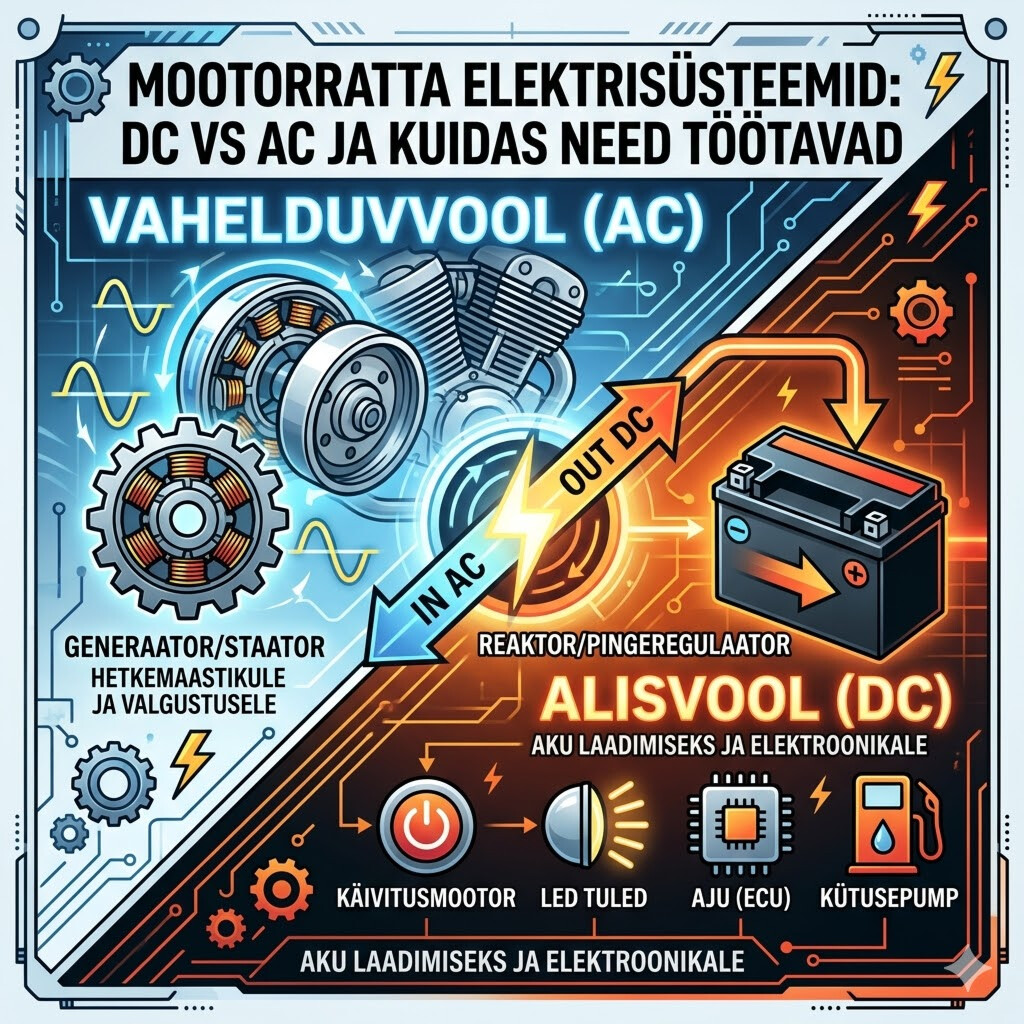
Modern motorcycles use a combination of AC (alternating current) and DC (direct current) electrical systems. Even though most riders think of the motorcycle electrical system as “12 volts DC,” the electricity actually begins as AC inside the engine’s charging system. It is then converted and regulated to DC so it can charge the battery and power most electrical components.
Understanding the difference between AC and DC helps when diagnosing charging problems, lighting issues, ignition faults, or battery drain.
1. Basic Difference Between AC and DC
DC: Direct Current
DC flows in one direction only.
A motorcycle battery supplies DC power. Most motorcycle electrical components use DC, including:
- Battery
- Starter motor
- ECU/ECM
- Fuel pump
- Fuel injectors
- LED lights
- Horn
- Turn signals
- Relays
- Sensors
- Cooling fan
- Digital dashboard
A typical modern motorcycle DC system is rated at 12 volts, but actual voltage varies:
AC: Alternating Current
AC changes direction repeatedly. The voltage rises and falls in a wave pattern.
In motorcycles, AC is produced by the stator/alternator when the engine is running. The AC output increases with engine speed.
AC is commonly found in:
- Stator windings
- Alternator output wires
- Some older headlight circuits
- Some CDI ignition systems
- Magneto systems on small motorcycles, dirt bikes, scooters, and ATVs
Unlike the battery, the stator does not produce a stable 12 volts. Depending on RPM and design, it may produce anywhere from 20 V AC to over 100 V AC before regulation.
2. Main Parts of a Motorcycle Electrical System
A motorcycle electrical system usually includes the following components:
- Battery
- Stator/alternator
- Rotor/flywheel
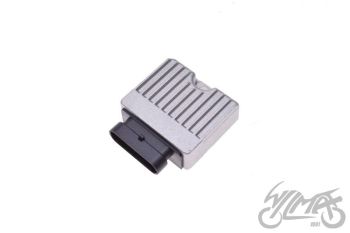
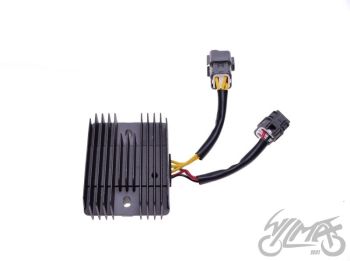
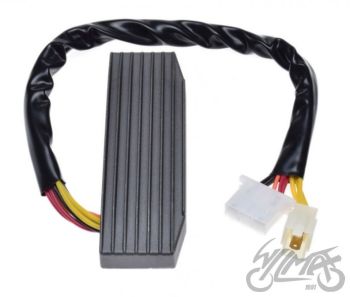
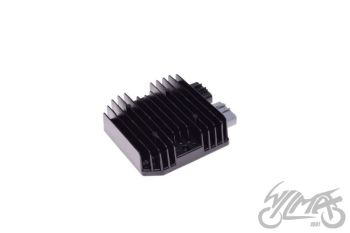
- Regulator/rectifier
- Starter motor
- Ignition system
- Wiring harness
- Fuses and relays
- Switches
- Lighting and accessories
- ECU and sensors on fuel-injected motorcycles
3. How Motorcycle Electricity Is Generated
Motorcycles usually generate electricity using a permanent magnet alternator.
Main Components
Rotor or Flywheel
The rotor contains strong permanent magnets. It is connected to the crankshaft, so it spins when the engine runs.
Stator
The stator is a stationary set of copper wire coils mounted inside or beside the flywheel.
When the magnetic rotor spins around the stator, the changing magnetic field induces voltage in the stator windings. This is called electromagnetic induction.
This generated electricity is AC.
4. Stator Output: Single-Phase and Three-Phase AC
Motorcycle stators are generally either:
Single-Phase Stator
A single-phase stator has one AC output winding or one pair of AC wires.
It is common on:
- Small motorcycles
- Scooters
- Dirt bikes
- Older motorcycles
Typical wire output:
- 2 AC wires from stator, or
- 1 AC wire and ground, depending on design
Single-phase systems are simpler but produce more pulsating power.
Three-Phase Stator
A three-phase stator has three separate AC windings spaced evenly around the stator.
It is common on:
- Larger motorcycles
- Modern street bikes
- Touring bikes
- Sport bikes
- Adventure bikes
Typical wire output:
- 3 yellow or white AC wires from the stator
Three-phase alternators are more efficient and provide smoother, higher power output.
5. Why Motorcycles Produce AC First
AC is easier to generate with a rotating magnet and coil arrangement. As the rotor magnet passes the stator coil, voltage is induced first in one direction, then the opposite direction. This naturally creates alternating current.
However, batteries cannot be charged directly with AC. Most motorcycle electronics also require DC. Therefore, the AC must be converted to DC.
This is the job of the rectifier.
6. What the Rectifier Does
A rectifier converts AC into DC.
It uses electronic components called diodes. A diode allows current to flow in only one direction. By arranging multiple diodes in a bridge circuit, the negative half of the AC waveform is flipped into a positive waveform.
This process is called full-wave rectification.
Before Rectification
The stator output looks like this conceptually:
AC waveform:
+ + +
/ \ / \ / \
/ \ / \ / \
/ \/ \/ \
\ /\ /\ /
\ / \ / \ /
\ / \ / \ /
- - -
After Rectification
The negative half is converted upward:
Rectified DC pulses:
+ + +
/ \ / \ / \
/ \ / \ / \
/ \/ \/ \
This is not perfectly smooth DC yet, but the battery helps smooth it.
7. What the Regulator Does
The stator output voltage rises as RPM increases. Without control, voltage could become too high and damage:
- Battery
- ECU
- Bulbs
- Sensors
- Ignition components
- LED lights
The voltage regulator keeps charging voltage within a safe range, usually around:
13.5 V to 14.8 V DC
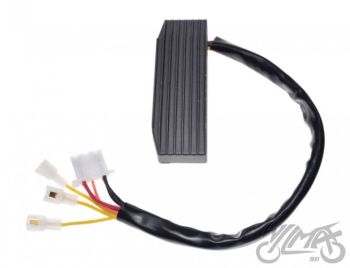
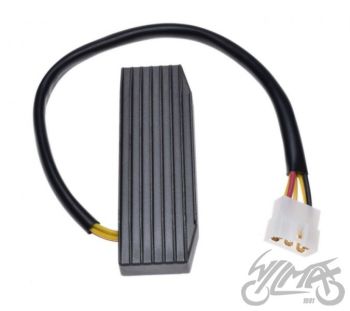
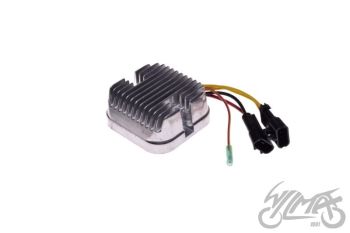
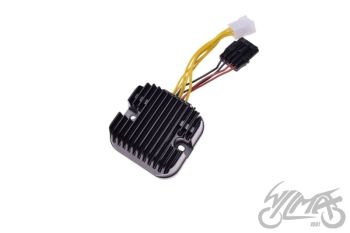
On many motorcycles, the rectifier and regulator are combined into one unit called the:
Regulator/Rectifier
or simply:
Reg/Rec
8. Types of Motorcycle Regulators
Shunt Regulator
A shunt regulator controls voltage by dumping excess stator power to ground as heat.
This is very common on motorcycles.
Advantages:
- Simple
- Reliable
- Affordable
Disadvantages:
- Generates heat
- Keeps stator heavily loaded
- Can contribute to stator overheating
Series Regulator
A series regulator controls voltage by opening and closing the stator circuit, reducing current flow when power is not needed.
Advantages:
- Runs cooler
- Reduces stator load
- More efficient
Disadvantages:
- More expensive
- Not installed on all motorcycles
MOSFET Regulator
A MOSFET regulator uses modern transistor technology for more efficient switching.
Advantages:
- Better voltage control
- Runs cooler than older silicon-controlled designs
- Often used as an upgrade
A MOSFET regulator can be either shunt-type or series-type depending on design.
9. Role of the Battery
The battery stores DC electricity and stabilizes the electrical system.
Main battery functions:
- Powers the starter motor
- Powers ignition and ECU before the engine starts
- Stabilizes voltage
- Supplies extra current when demand is higher than charging output
- Provides DC power at idle if the stator output is low
Most motorcycles use:
- Lead-acid battery
- AGM battery
- Gel battery
- Lithium iron phosphate battery, also called LiFePO₄
A healthy 12 V motorcycle battery should normally read:
12.6–12.8 V fully charged
12.2 V partially discharged
Below 12.0 V weak or discharged
10. DC Circuits on a Motorcycle
After AC is rectified and regulated, DC power is distributed through the motorcycle wiring harness.
Common DC circuits include:
Starter Circuit
The starter circuit uses high current. It includes:
- Battery
- Starter relay/solenoid
- Starter motor
- Heavy-gauge cables
- Ground connection
Starter current can be very high, often:
50–200 amps or more
depending on engine size and compression.
Ignition Circuit
The ignition system creates a high-voltage spark at the spark plug.
Modern systems are usually controlled by:
- ECU
- Crankshaft position sensor
- Ignition coil
- Spark plug
The ignition coil may receive 12 V DC and then step it up to thousands of volts.
Typical spark voltage can be:
15,000–40,000 volts
Lighting Circuit
Most modern motorcycles use DC lighting.
Common loads:
Power is calculated using:
Watts = Volts × Amps
For example, a 60 W headlight on a 12 V system draws:
60 W ÷ 12 V = 5 A
At charging voltage, 14 V:
60 W ÷ 14 V ≈ 4.3 A
11. AC Circuits on Motorcycles
Some motorcycles, especially older or smaller models, use AC directly for certain circuits.
AC Headlight Systems
On some dirt bikes, scooters, and small motorcycles, the headlight may run directly from the stator AC output.
In this design:
- Headlight works only when engine is running
- Brightness may increase with RPM
- Battery may be small or absent
- A regulator may limit AC voltage
This is often called an AC lighting system.
AC CDI Ignition
Some motorcycles use an AC CDI ignition system.
CDI means:
Capacitor Discharge Ignition
In an AC CDI system, the stator has a special charging coil that generates AC voltage for the CDI box. The CDI stores energy in a capacitor and releases it quickly into the ignition coil to make a spark.
AC CDI systems can often run without a battery.
Common on:
- Dirt bikes
- Scooters
- Small motorcycles
- ATVs
- Kick-start engines
DC CDI Ignition
A DC CDI system uses battery voltage or regulated DC power. The CDI internally steps up the 12 V DC to charge its capacitor.
DC CDI systems usually require a healthy battery or charging system.
12. Motorcycle Charging System Operation Step-by-Step
Here is the basic process:
- Engine starts and crankshaft spins.
- Rotor/flywheel magnets rotate around the stator.
- Stator coils produce AC voltage.
- AC voltage travels to the regulator/rectifier.
- Rectifier converts AC to DC.
- Regulator limits voltage to approximately 13.5–14.8 V.
- DC power charges the battery.
- Battery and charging system power the motorcycle’s electrical loads.
Simple flow diagram:
Engine rotation
↓
Rotor magnets spin
↓
Stator produces AC
↓
Regulator/Rectifier
↓
Regulated DC
↓
Battery + motorcycle electrical loads
13. Technical Details: Voltage, Current, Resistance, and Power
Motorcycle electrical diagnosis often uses basic electrical formulas.
Ohm’s Law
V = I × R
Where:
- V = voltage in volts
- I = current in amps
- R = resistance in ohms
Power Formula
P = V × I
Where:
- P = power in watts
- V = voltage
- I = current
Example:
If a heated grip set uses 36 W at 12 V:
I = P ÷ V
I = 36 ÷ 12
I = 3 A
So the heated grips draw about 3 amps.
14. Charging System Capacity
A motorcycle alternator has a maximum output rating, usually measured in watts.
Examples:
If accessories draw more power than the charging system can supply, the battery will slowly discharge even while riding.
Example:
Charging system output: 350 W
Motorcycle base load: 220 W
Available accessory power: 130 W
If you add heated gear, auxiliary lights, phone charger, and GPS totaling 180 W, the system may not keep up.
15. Common Charging System Problems
Weak or Dead Battery
Symptoms:
- Slow cranking
- Clicking starter relay
- Dim lights
- Dashboard resets
- Motorcycle starts with jump but dies later
Possible causes:
- Old battery
- Undercharging
- Parasitic drain
- Loose terminals
- Bad ground
Bad Regulator/Rectifier
Symptoms:
- Battery not charging
- Battery overcharging
- Blown bulbs
- Burnt electrical smell
- Voltage above 15 V
- Voltage stuck around 12 V while running
A failing regulator/rectifier may either stop charging or allow excessive voltage.
Bad Stator
Symptoms:
- Low charging voltage
- Battery dies while riding
- Burnt stator smell
- Dark or burned stator windings
- AC output low on one phase
- Short to ground
Stators can fail due to heat, insulation breakdown, or overload.
Poor Ground or Corroded Connector
Symptoms:
- Intermittent electrical faults
- Charging voltage unstable
- Lights flicker
- Starter weak despite good battery
- Melted connectors
Motorcycle electrical systems are very sensitive to poor connections because vibration, moisture, and heat affect wiring over time.
16. Basic Charging System Tests
A digital multimeter is very useful for motorcycle electrical diagnosis.
Battery Voltage Test
With engine off:
12.6–12.8 V = fully charged
12.3–12.5 V = partially charged
Below 12.0 V = discharged
Charging Voltage Test
Measure across the battery terminals with engine running.
At idle:
Approximately 12.8–14.2 V
At 3,000–5,000 rpm:
Approximately 13.5–14.8 V
If voltage stays near 12 V, the battery is not charging.
If voltage rises above 15 V, the regulator may be faulty.
Stator AC Output Test
Disconnect the stator from the regulator/rectifier.
Set the multimeter to AC volts.
For a three-phase stator, measure:
Wire A to B
Wire B to C
Wire A to C
At a specified RPM, all readings should be similar. Depending on the motorcycle, readings may be:
20–80+ V AC
Always check the service manual for exact specifications.
Stator Resistance Test
With the engine off and stator disconnected, measure resistance between stator wires.
For a three-phase stator:
A-B
B-C
A-C
All should be similar and usually very low, often less than 1 ohm.
Then check each stator wire to ground. There should normally be:
No continuity to ground
If a stator wire is shorted to ground, the stator is faulty.
17. AC vs DC on Motorcycles: Quick Comparison
18. Why Most Modern Motorcycles Use DC Systems
Modern motorcycles rely heavily on electronics. Fuel injection, ABS, traction control, ride-by-wire throttles, LED lighting, and digital dashboards all require stable DC power.
DC systems are better for:
- ECU operation
- Sensor accuracy
- Battery charging
- LED lighting
- Electronic accessories
- Starter systems
- Communication networks such as CAN bus
That is why modern motorcycles convert stator AC into regulated DC almost immediately.
19. Important Safety Notes
Motorcycle electrical systems are usually low voltage, but they can still be dangerous.
Important precautions:
- Disconnect the battery before major wiring work.
- Never short the battery terminals.
- Use correct fuse ratings.
- Avoid bypassing fuses.
- Do not run sensitive electronics with an overcharging system.
- Be careful around ignition coils because spark voltage can be tens of thousands of volts.
- Use a proper multimeter setting: AC volts for stator output, DC volts for battery voltage.
- Secure wiring away from exhaust heat, sharp edges, and moving parts.
Conclusion
A motorcycle electrical system uses both AC and DC. The stator produces AC electricity whenever the engine runs. This AC power is sent to the regulator/rectifier, which converts it into controlled DC voltage. The DC voltage then charges the battery and powers the motorcycle’s electrical components.
In simple terms:
Stator = produces AC
Rectifier = converts AC to DC
Regulator = controls voltage
Battery = stores DC power
Electrical system = uses regulated DC
Older and smaller motorcycles may use AC directly for headlights or ignition, but most modern motorcycles rely on regulated DC for stable and reliable operation. Understanding how AC and DC work in a motorcycle makes it much easier to diagnose problems, upgrade accessories, and maintain a healthy charging system.