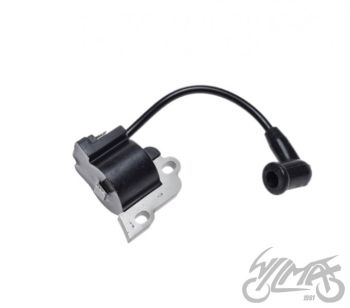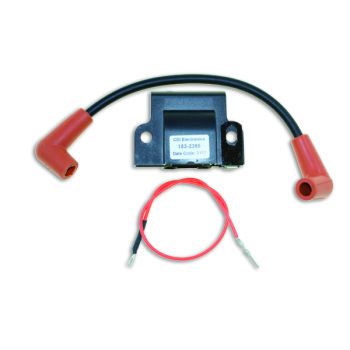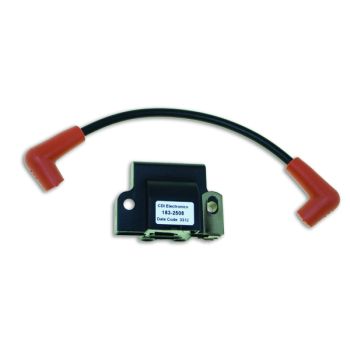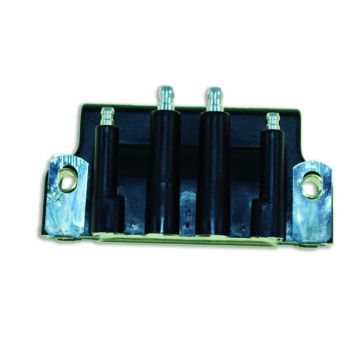







The ignition coil is one of the most important components of a gasoline engine’s ignition system. Its job is to convert the low voltage from the battery or ignition system into a very high voltage that can create a spark between the electrodes of the spark plug. Without a strong spark occurring at the right moment, the air-fuel mixture will not burn properly, and the engine may run unevenly, lose power, use more fuel, or fail to start at all.
Although the operating principle of an ignition coil is similar in many systems, the design and control of ignition coils have changed greatly over the years. Older vehicles used one large cylindrical ignition coil and a distributor, while newer vehicles often have a separate ignition coil for each cylinder. On motorcycles, lawn mowers, ATVs, and small engines, the ignition system may instead be magneto- or CDI-type.
Below, we will take a detailed look at what types of ignition coils exist, how they are built, how they differ, and how to measure and test them.
---
1. What is an ignition coil?
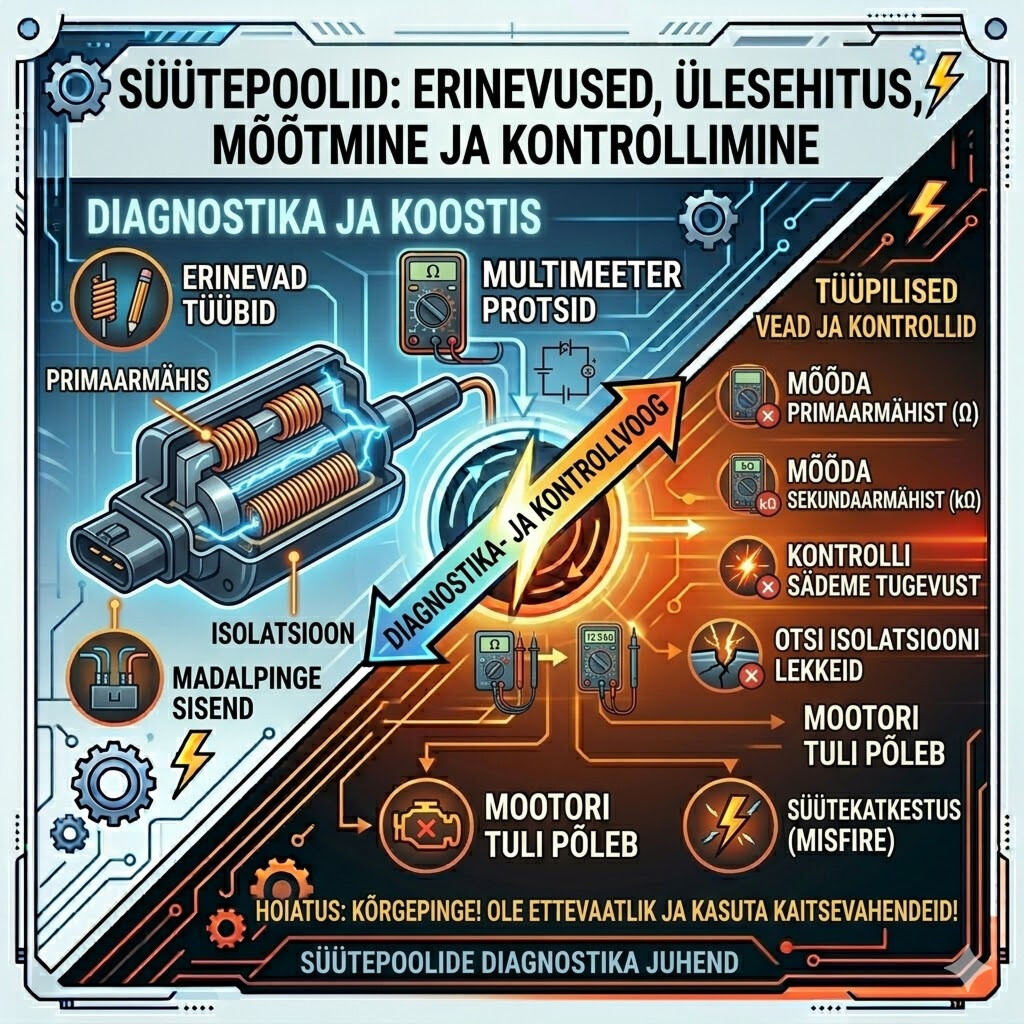
An ignition coil is essentially a high-voltage transformer. It usually consists of two windings:
- 1. Primary winding – a low-voltage winding that is usually supplied with 12 V or driven by an ignition control module.
- 2. Secondary winding – a high-voltage winding in which a voltage of tens of thousands of volts is generated.
When current is passed through the primary winding, a magnetic field is created in the core of the ignition coil. When the current is suddenly interrupted, the magnetic field collapses and high voltage is induced in the secondary winding. This high voltage travels to the spark plug and creates a spark.
A typical ignition coil can produce about 15,000–40,000 V, and in some cases even more. The actual required voltage depends on many factors:
- spark plug electrode gap,
- pressure in the cylinder,
- composition of the air-fuel mixture,
- condition of the spark plug,
- condition of the high-voltage leads,
- engine load,
- type of ignition system.
---
2. Basic construction of an ignition coil
Although ignition coils may differ in shape, most of them consist of the following parts:
- primary winding,
- secondary winding,
- iron or ferrite core,
- insulating material,
- housing,
- low-voltage terminals,
- high-voltage output,
- in some cases, a built-in ignition control module, or igniter,
- in some cases, an electronic control circuit.
Primary winding
The primary winding is made of thicker wire and has fewer turns. Its resistance is usually low, often below a few ohms. On some ignition coils, the resistance of the primary winding may be, for example, 0.3–3 Ω.
Current is controlled through the primary winding. As the current increases, energy is stored in the magnetic field. The more precisely and strongly this current is controlled, the better the ignition system works.
Secondary winding
The secondary winding is made of much finer wire and has a very large number of turns. Its resistance is higher, often in the range of several thousand ohms. For example, the resistance of the secondary winding may be 5 kΩ to 20 kΩ, and in some coils even more.
High voltage is generated in the secondary winding and directed to the spark plug.
Core
The core strengthens the magnetic field. It may be made of iron or ferrite. The shape and material of the core affect the ignition coil’s efficiency, heat generation, and spark strength.
Insulation
An ignition coil must withstand very high voltage. For this reason, the windings are covered with insulation, and oil, resin, or epoxy material is used inside the coil. If the insulation ages, cracks, or suffers heat damage, the high voltage may begin to arc to the wrong place.
---
3. Main types of ignition coils
3.1. Classic cylindrical ignition coil
Older vehicles usually had one large cylindrical ignition coil connected to the ignition distributor. The distributor directed the high voltage at the right time to the spark plug of the corresponding cylinder.
Features:
- one ignition coil for the entire engine,
- high voltage goes to the distributor,
- spark plug wires run from the distributor to the cylinders,
- used on older vehicles, tractors, and other machinery.
Pros:
- simple construction,
- inexpensive,
- easy to measure and replace.
Cons:
- the distributor and distributor cap can wear out,
- there are many ignition leads,
- high-voltage losses are greater,
- accuracy and reliability are poorer than in newer systems.
---
3.2. Distributorless ignition coil pack
Distributorless ignition systems often use an ignition coil pack that contains several ignition coils. One coil may serve two cylinders. This type of system is often called a wasted spark system.
For example, a four-cylinder engine may have one ignition coil pack with two ignition coils:
- one coil for cylinders 1 and 4,
- the other coil for cylinders 2 and 3.
A spark occurs in two cylinders at the same time: in one, the power stroke takes place; in the other, a “wasted spark” occurs during the exhaust stroke.
Pros:
- no distributor is needed,
- fewer mechanical wear parts,
- better reliability than a distributor-based system,
- easier to control electronically.
Cons:
- failure of one coil can affect two cylinders,
- high-voltage leads are still present,
- in some cases, fault finding is more difficult.
---
3.3. Coil-on-plug / COP
On newer gasoline engines, a very common solution is for each cylinder to have its own ignition coil directly on top of the spark plug. This is called a coil-on-plug, or COP, system.
Features:
- separate ignition coil for each cylinder,
- no spark plug wires, or they are very short,
- the ignition coil sits directly on top of the spark plug,
- control is handled by the engine control unit.
Pros:
- very precise ignition control,
- fewer high-voltage losses,
- no long spark plug wires,
- easier cylinder-specific diagnostics,
- better suited to modern engines.
Cons:
- ignition coils operate in a hot environment,
- moisture and oil in the spark plug well can damage the coil,
- each cylinder has a separate expensive component,
- access is difficult on some vehicles.
---
3.4. Pencil-type ignition coil
A pencil-type ignition coil is one form of a COP system. It is a long, narrow ignition coil that extends deep into the spark plug well. These are used on many modern engines.
Typical problems:
- cracking of the rubber boot,
- high-voltage arcing to the wall of the spark plug well,
- oil entering the spark plug well,
- misfiring caused by moisture,
- heat damage.
---
3.5. Coil-near-plug
On some engines, the ignition coil is not directly on the spark plug but near it. A short high-voltage lead runs from the ignition coil to the spark plug.
Pros:
- the ignition coil may not be exposed to as much heat,
- the high-voltage lead is short,
- maintenance may be easier.
Cons:
- the lead can still fail,
- there are more connection points than in a COP system.
---
3.6. CDI ignition coil
CDI means Capacitor Discharge Ignition. It is widely used on motorcycles, scooters, ATVs, lawn mowers, boat engines, and other small engines.
In a CDI system, a capacitor is charged to a high voltage and then quickly discharged into the primary winding of the ignition coil. The ignition coil transforms this into an even higher voltage.
Difference from conventional inductive ignition:
- an inductive system stores energy in the ignition coil’s magnetic field,
- a CDI system stores energy in a capacitor,
- a CDI spark is very fast and short,
- well suited to high rpm and small engines.
Important: A CDI ignition coil may not be suitable for a conventional 12 V inductive ignition system, and vice versa.
---
3.7. Magneto ignition coils
Small engines often use magneto ignition. In this system, the flywheel magnet generates the energy needed in the ignition coil. Such a system does not always require a battery.
Applications:
- lawn mowers,
- string trimmers,
- chainsaws,
- small ATVs,
- generators,
- older motorcycles.
A magneto ignition coil may also contain electronics that determine the ignition timing and interrupt the current at the right moment.
---
4. Inductive ignition system and CDI – an important difference
When testing an ignition coil, it is important to understand which system it is used in.
Inductive ignition system
This is used on most vehicles. The battery’s 12 V supply feeds the primary winding of the ignition coil. The engine control unit or ignition module switches the primary current on and off.
Typical:
- 12 V supply,
- primary current controlled by a transistor,
- longer charging time, or dwell,
- strong and relatively long spark.
CDI ignition system
With CDI, the coil does not operate in the same way. A short high-voltage pulse from a capacitor is sent into the primary winding of the ignition coil. Therefore, the resistance and construction of the primary winding are also different.
Typical:
- fast and short spark,
- suitable for small engines and high rpm,
- ignition coil resistances may differ from a conventional automotive coil,
- the wrong coil may prevent the system from working.
---
5. Symptoms of ignition coil failure
Ignition coil failure can appear in many ways. Sometimes the engine does not run at all; sometimes the problem appears only under load or when hot.
Common symptoms
- the engine misfires,
- the engine runs unevenly,
- starts when cold but not when warm,
- begins to stumble when warm,
- jerking occurs during acceleration,
- the engine lacks power,
- fuel consumption increases,
- exhaust gases smell like gasoline,
- the spark plug is wet or sooty,
- the “Check Engine” light is on in the dashboard,
- fault codes such as P0300, P0301, P0302, etc.,
- the catalytic converter may overheat,
- the vehicle does not start at all.
OBD fault codes
On modern vehicles, ignition coil failure often results in stored misfire fault codes.
Examples:
- P0300 – random or multiple-cylinder misfires,
- P0301 – cylinder 1 misfire,
- P0302 – cylinder 2 misfire,
- P0303 – cylinder 3 misfire,
- P0304 – cylinder 4 misfire,
- P0351–P0362 – ignition coil primary/secondary circuit faults, depending on the cylinder and manufacturer.
It is important to understand that a misfire code does not always mean an ignition coil failure. The same symptom can also be caused by the spark plug, injector, compression problem, vacuum leak, wiring, or engine control unit.
---
6. Safety when testing an ignition coil
An ignition coil operates at very high voltage. Although the current is low, an electric shock can be painful and, in certain situations, dangerous.
Safety rules
- Do not hold the ignition coil, spark plug lead, or spark plug with your bare hand while the engine is running.
- Do not unplug the ignition coil connector while the engine is running unless the manufacturer allows it.
- Do not test the spark in a way that lets the high voltage jump randomly toward the engine or control unit.
- Use a proper spark tester.
- Keep high-voltage leads away from fuel vapors.
- Do not let the ignition system operate without a suitable ground path for the spark, because this can damage the ignition coil or control module.
- If the engine has an LPG/CNG system or a fuel leak, be especially careful.
---
7. Visual inspection of the ignition coil
Before measuring, it is worth performing a thorough visual inspection. Many problems are visible.
Check the following
- whether there are cracks in the ignition coil housing,
- whether the plastic has melted or swollen,
- whether there is a burnt smell,
- whether there are signs of high-voltage arcing,
- whether the rubber boot is cracked,
- whether there is oil in the spark plug well,
- whether there is water or moisture in the spark plug well,
- whether the connector is oxidized,
- whether the contacts are green or black,
- whether the wires are broken or chafed,
- whether the spark plug is correct and in good condition.
A high-voltage tracking mark may look like a fine black or gray line on the coil boot or spark plug porcelain. This is often called “carbon tracking.” If such a mark is present, the spark may travel along the track to ground instead of between the spark plug electrodes.
---
8. Measuring an ignition coil with a multimeter
A multimeter is a simple aid, but it has limitations. Measuring resistance only shows whether a winding is completely open or shorted. It may not reveal a fault that appears under high voltage, heat, or load.
Still, measuring with a multimeter is a good first step.
---
9. Measuring primary winding resistance
The primary winding is the low-voltage side. Its resistance is usually low.
How to measure?
- 1. Turn the ignition off.
- 2. Disconnect the ignition coil connector.
- 3. If possible, remove the ignition coil from the engine.
- 4. Set the multimeter to the ohms measurement mode.
- 5. Measure the resistance between the ignition coil’s primary terminals.
- 6. Compare the result with the manufacturer’s specifications.
Typical values
The primary winding resistance of an inductive ignition coil may be approximately:
- 0.3–1.5 Ω on modern coils,
- 1–3 Ω on older coils,
- 3 Ω or more on some points-type systems,
- values may be different on CDI coils.
Note when measuring low resistance
When measuring very low resistance, the resistance of the multimeter leads themselves can affect the measurement result.
For example, if the test leads have a resistance of 0.3 Ω and the actual coil resistance is 0.6 Ω, the multimeter may show 0.9 Ω.
It is recommended to touch the multimeter probes together before measuring and see how much the leads themselves read. This value must be subtracted from the measured result.
---
10. Measuring secondary winding resistance
The secondary winding is the high-voltage side. Its resistance is much higher than that of the primary winding.
How to measure a classic coil?
- 1. Set the multimeter to the kilo-ohm range.
- 2. Place one probe into the high-voltage output.
- 3. Place the other probe on the corresponding primary terminal or the other high-voltage output, depending on the coil design.
- 4. Compare the result with the technical specifications.
Typical values
The resistance of the secondary winding may be approximately:
- 5 kΩ to 15 kΩ on classic coils,
- 8 kΩ to 20 kΩ on many coil pack type coils,
- on some COP coils, the secondary winding may not be measurable in the usual way,
- on coils with built-in electronics, a multimeter may show unusual results.
Measuring a wasted spark coil
In a wasted spark system, there are often two high-voltage outputs at the ends of one winding. In this case, the secondary winding is measured between the two spark plug wire outputs.
If a four-cylinder engine has a coil pack with outputs 1–4 and 2–3, you would measure, for example:
- between outputs 1 and 4,
- between outputs 2 and 3.
Both results should be similar.
---
11. Why can a multimeter test be misleading?
An ignition coil may appear fine according to a multimeter but still fail to work in the engine. There are several reasons:
- insulation only breaks down under high voltage,
- the fault appears only when hot,
- the winding opens due to vibration,
- internal electronics fail under load,
- the coil produces a weak spark, but resistance is within specification,
- moisture causes arcing only under certain conditions.
For this reason, an ignition coil should not be judged only by resistance. Resistance measurement is useful, but it is not definitive proof.
---
12. Testing an ignition coil with a spark tester
One of the most practical methods is using a spark tester. A spark tester creates a controlled gap that the spark must jump across.
Why not just put the spark plug against the engine?
In the past, spark was tested by removing the spark plug, attaching it to the end of the spark plug wire, and resting it against engine ground. On modern vehicles, this is not the best method because:
- a spark may be too easy to create in open air,
- under pressure in the cylinder, creating a spark is much more difficult,
- high voltage may find the wrong path and damage electronics,
- the test does not show the ignition coil’s actual capability.
How to use a spark tester?
- 1. Connect the tester to the ignition coil or spark plug wire.
- 2. Connect the other end of the tester securely to ground.
- 3. Start the engine or crank it with the starter.
- 4. Observe the strength and regularity of the spark.
- 5. Compare the cylinders with one another.
A strong spark is usually bluish or violet and occurs regularly. A weak yellowish spark may indicate a problem, but color alone is not always a sufficient assessment.
---
13. Swapping ignition coils between cylinders
On cars with a COP system, one of the simplest diagnostic methods is swapping ignition coils with each other.
Example:
- The car shows fault code P0302, meaning a cylinder 2 misfire.
- You swap the cylinder 2 ignition coil with the cylinder 4 ignition coil.
- You clear the fault codes.
- You take a test drive.
- If the fault moves to cylinder 4 and P0304 appears, the ignition coil is probably faulty.
- If the fault remains on cylinder 2, the problem should be looked for in the spark plug, injector, compression, or wiring.
This method is very useful because it does not require complicated measuring instruments.
---
14. The role of the spark plug in ignition coil failures
A faulty or incorrect spark plug can damage the ignition coil. If the spark plug electrode gap is too large or the plug is worn, the ignition coil must produce a higher voltage. This increases the load on the insulation and may cause arcing.
Check the spark plug
- Is the spark plug the correct type?
- Is the electrode gap correct?
- Is the spark plug worn?
- Are there cracks in the porcelain?
- Is the spark plug oily?
- Is the spark plug sooty?
- Are there high-voltage tracking marks on the porcelain?
When replacing an ignition coil, it is often wise to check or replace the spark plug as well. A new coil with an old and worn spark plug may quickly become damaged again.
---
15. Checking high-voltage leads
If the system has spark plug wires, these must also be checked. A bad spark plug wire can cause the same symptoms as a faulty ignition coil.
Inspection methods
- visual inspection for cracks,
- observing the running engine in the dark for arcing,
- measuring resistance,
- comparing the wires with one another,
- misting with water using a spray bottle to find moisture-sensitive arcing.
Measuring resistance
The resistance of spark plug wires depends on the type and length of the wire. Some resistor wires may have several kilo-ohms per meter. It is important to compare with the manufacturer’s data or compare wires of similar length with each other.
If one wire differs greatly from the others, it is suspicious.
---
16. Checking power supply and control signal
A modern ignition coil does not work on its own. It must have the correct power supply, ground, and control signal.
A COP coil connector may have
- 12 V supply,
- ground,
- control signal from the engine control unit,
- in some cases, a feedback signal,
- connections for a built-in ignition module.
Some ignition coils have 2 wires, some 3, and some 4 or more.
Check the power supply
- 1. Turn the ignition on.
- 2. Measure at the connector to see whether battery voltage reaches the ignition coil.
- 3. Check fuses and relays.
- 4. If there is no power, the fault may not be in the coil.
Check the ground
A poor ground can cause a weak or missing spark. Measure voltage drop in the ground circuit or check the connection with a multimeter and a test lamp under load.
Check the control signal
An oscilloscope or a dedicated diagnostic tool is best for checking the control signal. A fast pulse can be difficult to see with a regular multimeter.
---
17. Testing an ignition coil with an oscilloscope
An oscilloscope is the most accurate tool for analyzing the ignition system. It allows you to view the primary and secondary voltage waveforms and, in some cases, the current ramp.
What can be seen with an oscilloscope?
- primary voltage rise,
- primary current rise,
- dwell time,
- spark burn time,
- firing voltage,
- secondary voltage behavior,
- coil saturation,
- interruptions,
- control unit signal,
- anomalies caused by coil overheating.
Primary current ramp
In an inductive ignition system, the primary current increases over a certain period of time. If the current rise is incorrect, the cause may be:
- the ignition coil,
- supply voltage,
- ground connection,
- control module,
- engine control unit.
Spark burn time
Spark burn time shows how long the spark remains between the spark plug electrodes. If it is too short or unstable, the problem may be in the spark plug, coil, mixture, or the mechanical condition of the cylinder.
---
18. Ignition coil faults that appear when hot
A very common situation is when an ignition coil works when cold but begins to fail when warm.
Why does this happen?
- the winding wire expands with heat,
- an internal break opens up,
- insulation weakens,
- the electronic module overheats,
- epoxy or resin has cracked.
How to check?
- Warm the engine to operating temperature.
- Observe whether the misfire appears when warm.
- Use a diagnostic tool to monitor misfire counters.
- Swap the suspect coil with another cylinder.
- In some cases, the suspect coil can be warmed with a hot air gun, but this must be done carefully.
---
19. Moisture-related faults
If the engine starts misfiring in rainy weather or after washing, there is probably a high-voltage arcing problem in the ignition system.
Typical locations
- cracked ignition coil housing,
- damaged rubber boot,
- spark plug wire,
- distributor cap,
- spark plug well,
- connectors.
Inspection
- Observe the running engine in the dark.
- Spray a very light mist of water around the ignition components.
- Watch for spark jumping or changes in engine operation.
- Check insulation and rubber parts.
When spraying water, be careful not to create short circuits or damage electronics.
---
20. Testing ignition coils on small engines
Lawn mowers, string trimmers, chainsaws, and small ATVs often use magneto ignition.
Typical checks
- 1. Check the spark plug.
- 2. Check the spark plug wire and cap.
- 3. Check the stop switch – it may short the ignition to ground.
- 4. Measure the ignition coil resistance if the manufacturer provides data.
- 5. Check the air gap between the ignition coil and the flywheel magnet.
- 6. Use a spark tester.
Air gap between the flywheel and ignition coil
On many small engines, the gap between the ignition coil and the flywheel magnet must be a specific value, for example about 0.2–0.4 mm, depending on the engine. An incorrect air gap can cause a weak or missing spark.
A thin business card or a special feeler gauge is often used as a simple method, but the most correct approach is to follow the manufacturer’s specifications.
---
21. Measuring a CDI ignition coil
Measuring a CDI coil differs from measuring a conventional automotive coil. Resistance values can be very different, and without manufacturer data it is difficult to decide whether the coil is good.
What should be checked in a CDI system?
- ignition coil primary winding resistance,
- secondary winding resistance,
- spark plug cap resistance,
- CDI unit output,
- pulse sensor/pickup coil,
- stator charging winding,
- stop switch,
- ground connections.
With small engines, people often mistakenly assume the ignition coil is faulty, even though the actual cause is the stop switch, pickup sensor, stator, or CDI unit.
---
22. Typical ignition coil faults
22.1. Open primary winding
If the primary winding is broken, no magnetic field is created and the coil does not work.
Features:
- primary winding resistance is infinite,
- no spark,
- the control unit may store a primary/secondary circuit fault code.
22.2. Open secondary winding
If the secondary winding is broken, high voltage does not reach the spark plug.
Features:
- secondary winding resistance is infinite,
- no spark or a very unstable spark.
22.3. Internal short circuit
If part of the winding is shorted, the coil may still work, but the spark is weak.
Features:
- the engine misfires under load,
- the coil heats up,
- resistance may be lower than specified,
- an oscilloscope shows an abnormal current rise.
22.4. Insulation breakdown
High voltage finds an easier path to ground than across the spark plug electrodes.
Features:
- cracked housing,
- black marks on the coil boot,
- problem in damp weather,
- misfiring during acceleration,
- visible spark in the dark.
22.5. Built-in ignition module failure
Many modern coils contain electronics. This type of fault may not be revealed by measuring resistance.
Features:
- the coil works intermittently,
- cuts out when hot,
- control signal is present, but there is no spark,
- power and ground are OK.
---
23. Replacing an ignition coil
If the ignition coil is faulty, it must be replaced with the correct type of part.
What to watch for?
- exact engine model,
- type of ignition system,
- connector shape and number of contacts,
- coil length,
- mounting method,
- resistance and electrical characteristics,
- whether the coil has a built-in ignition module,
- whether it is a CDI or inductive coil.
A cheap, low-quality ignition coil may work for only a short time or cause new problems. Modern engines are especially sensitive, because the ignition coil must match the control logic of the control unit.
---
24. Should all ignition coils be replaced at once?
It depends on the situation.
Replacing one coil makes sense if:
- only one coil is faulty,
- the others are in working order,
- access is easy,
- the vehicle’s value or budget does not justify replacing all of them.
Replacing all coils may make sense if:
- the engine has high mileage,
- the coils are a known weak point,
- there are repeated problems on several cylinders,
- access is very labor-intensive,
- the spark plugs are also being replaced and major maintenance is being performed.
In practice, often only the faulty coil is replaced, but the spark plug is definitely checked at the same time.
---
25. Common mistakes when diagnosing an ignition coil
The coil is replaced, but the spark plug is not checked
A worn spark plug may be the reason the coil failed.
Assuming that P0301 always means a coil failure
A misfire can also come from the injector, compression, a vacuum leak, or wiring.
Only resistance is checked
Resistance may be OK, but the coil may arc under high voltage.
The wrong ignition coil is used
A coil that looks similar externally may not be electrically compatible.
Power and ground are not checked
If the coil does not receive power or a control signal, installing a new coil will not help.
Oil in the spark plug well is ignored
Oil damages rubber boots and causes high-voltage arcing. An oil leak from the valve cover gasket must be repaired.
---
26. Practical diagnostic sequence
If you suspect an ignition coil fault, you can proceed according to the following logic.
- 1. Read the fault codes.Check whether there are misfire or ignition coil circuit fault codes.
- 2. Check the spark plugs.An incorrect or worn spark plug can cause the same symptom.
- 3. Visually inspect the ignition coil.Cracks, high-voltage tracking, oil, or water in the spark plug well are important clues.
- 4. Swap the coil with another cylinder.If the fault moves with the coil, the coil is probably faulty.
- 5. Measure the primary and secondary windings if possible.
- 6. Check power, ground, and control signal.
- 7. Use a spark tester.
- 8. Use an oscilloscope if necessary.
- 9. Do not forget mechanical and fuel system causes.
---
27. Summary
The ignition coil is a central part of the ignition system, and its job is to create sufficiently high voltage at the spark plug for a strong spark. The main types of ignition coils are classic distributor coils, distributorless ignition coil packs, coil-on-plug coils, pencil-type coils, CDI coils, and magneto ignition coils.
An ignition coil can be tested in several ways: visually, with a multimeter, with a spark tester, by swapping it between cylinders, with a diagnostic tool, and with an oscilloscope. Simple resistance measurement provides useful information, but it does not always prove that the coil works properly under load. Many faults appear only when hot, in moisture, or under high cylinder pressure during acceleration.
Good diagnosis always begins by looking at the whole picture: ignition coil, spark plug, wiring, power supply, ground, control signal, engine mechanics, and fuel system. Choosing the correct ignition coil and installing it properly help prevent repeated failures and ensure smooth engine operation.